Meet Microsoft Outlook 2003
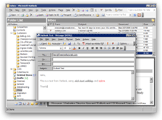 Microsoft Outlook has been part of the Microsoft Office productivity suite since Office 97.
Microsoft Office being the most widely used productivity suite in the business world, Outlook has quickly become the standard business email program. However, Outlook 2003's ease-of-use and flexibility make it an ideal Personal Information Manager choice even outside a business context.
Calling Microsoft Outlook an email program is very reductive: "Personal Information Manager" is probably more accurate. Outlook includes calendaring and scheduling functionality, not to mention a smooth integration with other Microsoft Office applications. Our tutorial will mostly focus on Outlook 2003's functionality as an email client.
| Made By | Microsoft Corporation |
|---|---|
| Price | US $109 (List Price) |
| Software Type | Shareware (What is Shareware?) |
| Product Home Page | Microsoft.com/Outlook 
|
Differences between Outlook 2003 and Outlook Express
Microsoft offers two desktop email clients: Outlook 2003 and Outlook Express.
Outlook 2003, part of the Office productivity suite, includes meeting, calendaring and task management functionality. It retails at about US$100, or bundled in Office 2003 editions.
Purely from an email functionality perspective, Outlook 2003 and Outlook Express are very close.
In a business environment, where most people use Microsoft Office, Outlook clearly surpasses Outlook Express with its collaboration tools, (even without a SharePoint or Exchange server).
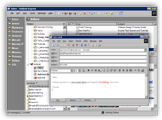 Outlook Express, on the other hand, is a (more) simple email client that ships free, included with Windows and Internet Explorer.
While a very decent email program itself, Outlook Express does not offer the array of features Outlook 2003, especially integration with Microsoft Office applications.
As an email client for your personal email accounts and home usage, Outlook Express has more features than most people will ever use.
Microsoft has realized the confusion that came from naming two similar products with the word "Outlook". In the next version of Windows, Windows Vista, a new email client is included with the operating system: Windows Mail. For all practical purposes, Windows Mail is the next version of Outlook Express, re-baptized to avoid confusion.
Microsoft has published on its website a comparative table of features between Outlook 2003 and Outlook Express.
Comparing Outlook and Outlook Express
Learning Outlook 2003 as a Career Investment
There are quite a few very decent email programs available, many of them free. But Microsoft Outlook is de facto the standard email+calendaring application in the business world.
 Mastering Outlook will go a long way in your career advancement, especially with an understaffed or absent IT Department. Regardless of your position, a serious knowledge of Office programs like Word, Excel or PowerPoint will help you. In fact, many employers require a good knowledge of these programs before even considering your application.
By the time you finish reading our Outlook 2003 tutorial, there won't be much left to learn before you can call yourself a "Power User" on Outlook's email functionality. Good luck!